
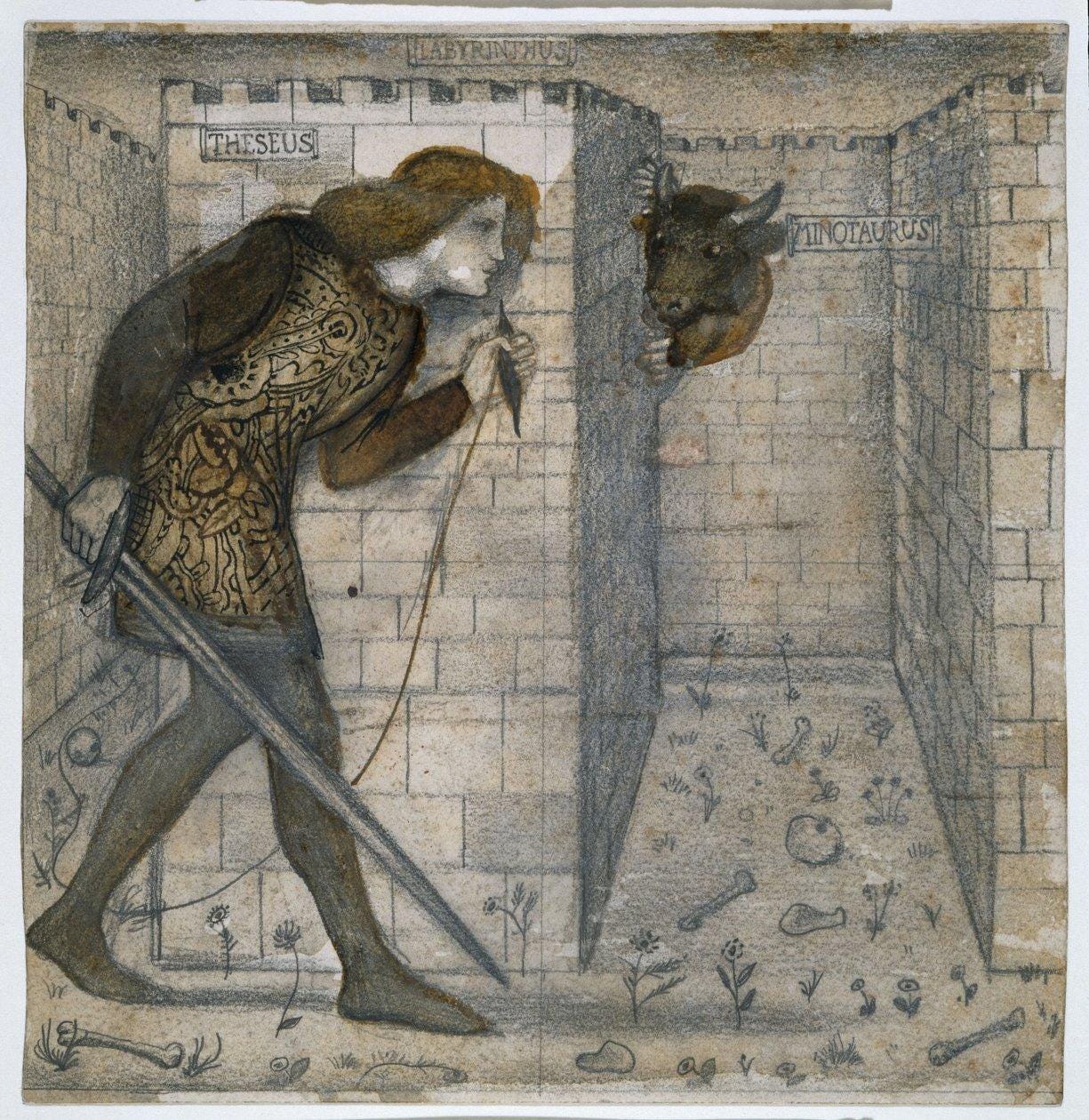
Theseus and the Minotaur. Edward Burne-Jones, 1861.
“Good judgement is the result of experience, and experience the result of bad judgement.”
– attributed, probably apocryphally, to Mark Twain
Synopsis: Agentic scientists can do science: they can make choices, observe the physical consequences of those choices, and decide what to do next. Scaling the number of these experimental cycles may improve agentic ability, but running new physical experiments is too slow and expensive to do thousands or millions of times. To address this, we scaled experimentation in a way that made the experience reusable. We measured millions of small molecules against many proteins and then turned those results into replayable experimental worlds that agents can explore at compute speed. We call the system Minos. In this post, accompanying preprint, and data release, we show that different models behave very differently in these worlds and use chemical feedback to inform their decisions. Across many thousands of experimental choices, we can see not just what these agents discover, but how they behave as they explore uncertain worlds.
preprint: https://github.com/Leash-Labs/minos-paper/blob/trunk/Minos_Leash.pdf
data release: https://strelka.leash.bio/
In 1948, Alan Turing proposed the idea of “thinking machines”. To see if a machine is thinking, you have to get it to do something, which posed a bit of a problem. Mulling it over, he suggested that games, cryptography, and math could be good test cases: “[these are] good in that they require little contact with the outside world” for evaluation or learning (ref 1).
A year later, Claude Shannon described the earliest attempts to get machines to play chess (all the way back to 1914, ref 2). He then went on to show a framework of what might be required to do it well: a general understanding of what pieces are capable of doing, evaluating the state of play on the board, and so on.
Within a few years, other researchers had shown examples of machines learning (ref 3). Shortly after we got computers playing checkers, and, crucially, computers playing each other to gain experience (ref 4, back in 1959). When neural nets and reinforcement learning were thrown in, computers achieved world-class game performance surprisingly fast (ref 5, 1995).
From there, it was a short hop to computers getting really good at Atari games (ref 6, ref 7) and Go (ref 8) and then Go with minimal human teaching by using self-play instead (ref 9). Once they got a little traction, computers got very very good at these sorts of tasks, and a key reason is that they got to try the tasks over and over and over again against an uncertain environment or opponent.
Games are replayable environments. What about science?
A nice thing about games like checkers and chess and Go and Atari are that they are composed of decision landscapes with rules. Each game requires a sequence of choices made by the player, those choices all have consequences, and as Turing noted, require little contact with the outside.
In the outside world, gaining experience through feedback is expensive. You have to go out and physically do the thing: you have to fold the piece of paper and throw it to see if it flies, and if it does not, you have to get another piece of paper and try again. You get on a bike for the first time, fall over, scrape your knee, and contemplate getting on a second time. You have to launch the rocket to see if it crashes; you have to build the cathedral to see if it topples. You have to put the drug in human beings to see if it helps or hurts or does nothing. It’s painful to do tens of these and impossible to do millions.
Games are different. With a clean set of consequences in a little world, you can get a computer to play as many games as you like, and those can all be pretty different from each other while the computer explores the action space. Millions? More than that? Why not? With games, experience is cheap.
In biology, we have had no such luxury.
In biology, we have to go into a laboratory and move liquids around from one tube to another. We have to grow cells like we’re farmers and pay close attention to them to see if something’s going wrong. We have to cut little slices of tissue and put them on pieces of glass and put that glass under a microscope. We have to synthesize chemicals over the course of weeks in the hope they will influence a protein (which we also have to make), and we take the feedback from that test to synthesize yet more chemicals, hoping to do better. With biology, experience is expensive. If you want computers to get good at it, you want them to make experimental choices and encounter the consequences of those choices. You want this to happen a lot, on a timescale that doesn’t cripple us. How can we do it?
Biologists and other physical scientists have noticed this conundrum and have come up with a couple of solutions.
Solution 1: Make experience cheap with simulations
In May, a clever group of scientists put together a framework where computers performed a number of medicinal chemistry tasks, from scaffold-hopping to lead optimization (SMDD-bench, ref 10). These tasks required sequential decisionmaking, and since physically making molecules and testing them iteratively in the lab is slow and expensive, they used current computational tools to evaluate if the molecules they were synthesizing were likely to work.
This is a fine strategy, but current computational tools to evaluate these things often aren’t perfect. For example, to test for binding, the group uses a cofolding model, and such models are prone to memorization and have obvious failure modes (ref 11, ref 12). We’re not particularly good at simulating most of biology yet, and this approach might be teaching the computers the wrong things. So, maybe not great experience, but definitely cheap.
Solution 2: Make experience cheap by replaying history
One neat way to create cheap scientific experience is to replay experiments that have already happened. Several groups have taken historical records of scientific discovery - medicinal chemistry campaigns are a particularly natural example - and turned them into virtual environments. An agent chooses what experiment it would do next, and the historical record tells it what happened when the original scientists performed that experiment.
This is appealing: experiments conducted in the physical world that originally took years and millions of dollars can be replayed by a computer in seconds (ref 13). However, we see two major problems with this approach.
You can never try the things that the original scientists didn’t try. It’s too late! Your computer may want to see what happens if it picks this new chemical moiety, but if it’s not in the historical record, it can’t. Legacy data is missing counterfactuals.
The historical record was produced by human beings who thought the things they tried were likely to work. All scientists operating in the physical world have limited experimental budgets, and they’re not going to blow those budgets on corners of space they think will be unproductive. But if you’re trying to teach a computer, you very much want it to be able to try those corners: maybe they’re good or maybe they’re bad, but you want the computer to discover that on its own. We think this problem of humans favoring certain types of chemistry is so bad we wrote a whole paper about it (ref 14, ref 15).
Solution 3: Accept that experience is expensive and sequentially generate new data
An increasing number of groups have decided that the path forward is to allow computers to design physical experiments and then run those physical experiments. FutureHouse/Edison, Lila Sciences, and the frontier AI labs have all announced efforts in this regard. Demand is sufficiently large that automated labs have sprung up or pivoted to meet it (e.g. Ginkgo, Strateos, Medra, Substrate, the US National Science Foundation’s Programmable Cloud Laboratories). In the weeks while this piece was being written, Periodic released some lab-in-the-loop results (ref 16); so did C5R Corp (ref 17), so did Lila (ref 18).
We believe this approach is better, but it still has some limitations.
Each step still takes days to months. Physical understanding across more than a short number of iteration cycles will require enormous patience.
Limited experimental budgets will restrict the space explored and the number of cycles. Similar to replaying history, these datasets will bear the fingerprints of their creators. Computers will choose a small number of options, and those choices alone will restrict access to counterfactuals. You’re going to have to keep generating fresh data to teach the computers new things and are subject to those fiscal and temporal punishments.
What if we could make science more like an Atari game?
Cheap experience through nearly-instant simulations is pretty appealing, except for the part where it’s not made from physical measurements. We want our models to learn something about the physical world, but we don’t want to wait around forever. We want the models to be able to choose from a large number of counterfactuals, not just things somebody thought would work. Is there a way to enable a model to choose between vast numbers of options that are counterfactually dense, have those options be physically grounded, but get consequences at a speed resembling that of computation?
Here is where we introduce Minos, a framework of premeasured experimental worlds.
To get around the problem of having long latency times with a lab-in-a-loop, we deliberately premeasured an enormous experimental landscape and let agentic scientists play inside it. Conceptually, it’s pretty simple: look at figure 1. In this toy example, we premeasured the binding enrichment of a bunch of molecules to a protein target. The idea is to give an agentic scientist a task - our current favorite is “find the best binder out of a large number of molecules” - but only give it a very limited budget of molecules to actually try.
Because the molecules were made in a combinatorial way (see here for an explanation), each individual row has a shared building block across all molecules, and so does each column. When an agent orders experiments along a row or a column, it gets information about members from the same chemical series, which could help the agent make future choices.
By making a limited number of decision paths through the dataset, the agent is effectively conducting a rudimentary structure-activity relationship (SAR) medicinal chemistry campaign. In the traditional biotech sense, we’re not running ADMET on these; it’s purely searching for better binders to a single target. But here’s the thing: by premeasuring the landscape, we have the outcome of all possible SAR campaigns of this type in this chemical space.
It’s an enormous number of campaigns. For our ~6.3M member chemical library, it’s ~10^638 potential trajectories for a single target.
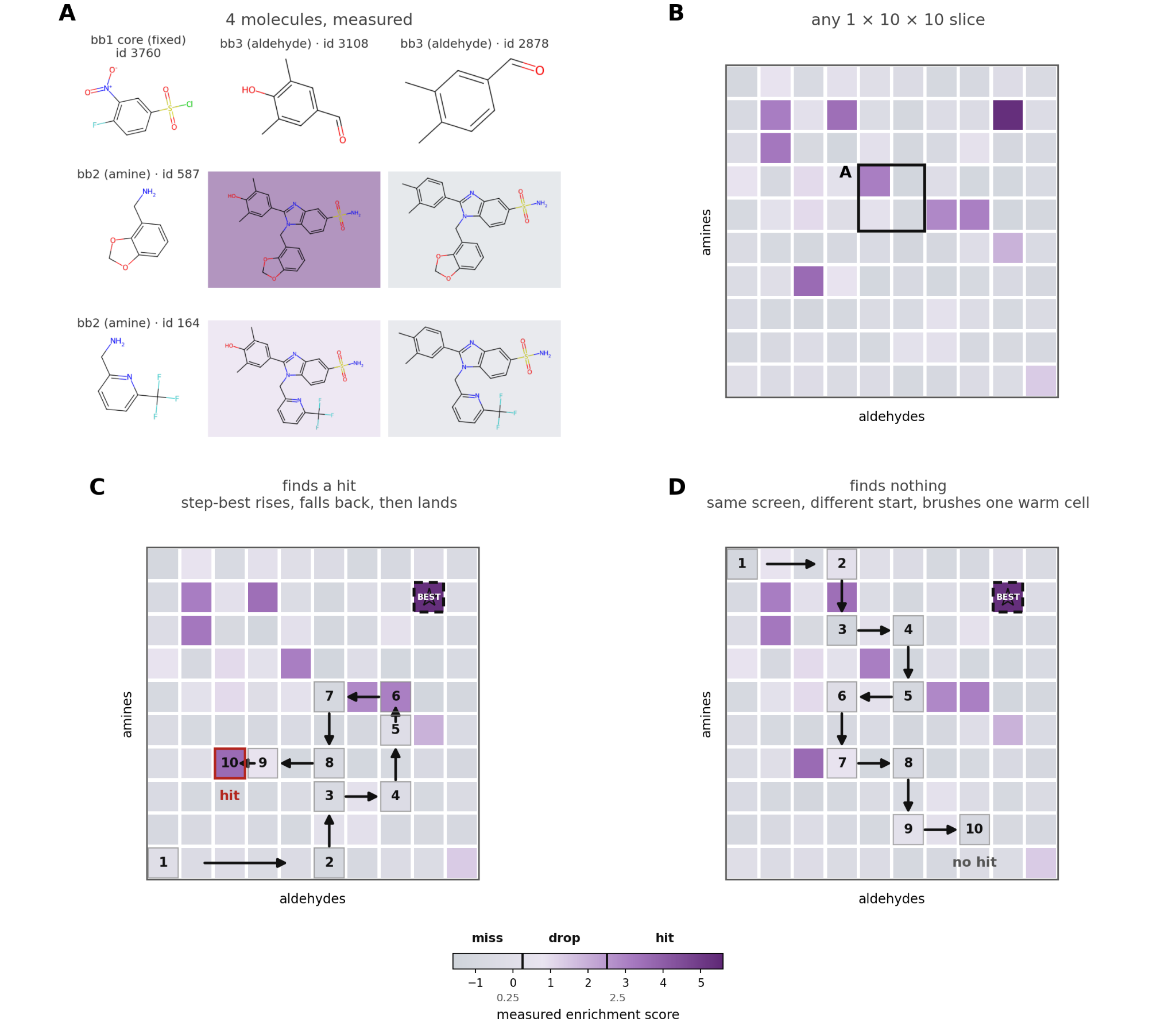
Figure 1. Each combination of a protein target and small molecule collection (“Minos environment”) comprises a premeasured experimental world, where agents can make sequential choices and experience the physical consequences of those choices. Note the best hit in this 100 molecule collection went undiscovered.
The beauty of premeasuring an entire experimental world means that we can evaluate what an agent says it’s going to do and why, what it actually does, what the physical consequences are for that choice, and the experimental outcomes of all choices it could have made but did not. This property is rare: normally you’re looking at legacy datasets that didn’t collect it, and conventional lab-in-the-loop strategies have to run all those counterfactuals to get the answer.
Minos has limitations but also enormous scale
It’s true that if we want to go fast, the agents are restricted to choosing among molecules we’ve already screened. (We can always have agents choose molecules from elsewhere, but then we’d have to order or synthesize and test them individually, which takes much more time and capital.) Fortunately, we have a lot of choices in our worlds. We have multiple chemical libraries of at least a million molecules each and hundreds of targets screened against them. We’re using these results to expand to new chemical neighborhoods and large numbers of mutations per target. It gets big very, very fast. Our current rate of increase is about 2 new environments a day, and in the near term that should get up to 20.
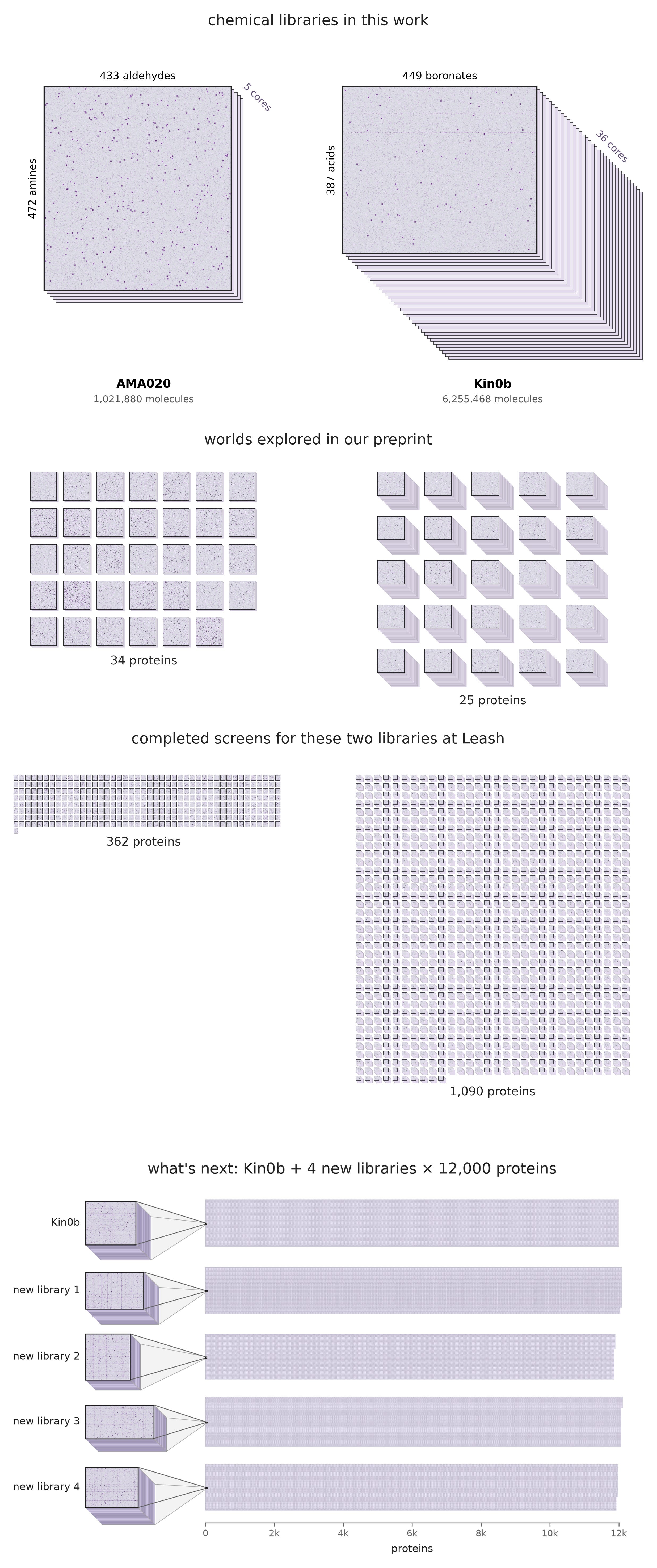
Figure 2. Scale of chemistry and worlds in this preprint, at present-day Leash, and plans for Leash in 2027.
Building these worlds takes work. We spent a huge amount of effort boosting signal and making them reproducible. But once we build them, it’s easy to let agents play in them: each run is just compute, not more physical wet lab collection. In the last six weeks, we’ve had agents run about 100,000 independent SAR trajectories through Minos environments.
These worlds have taught us a lot of things recently. Here are a couple of them.
Model strength and effort level affect performance
A flagship Minos task we put together goes like this: here are a million or more small molecules and here is a protein target. You get a budget of 100 molecules; you can test up to 5 at a time, and you get no starting points. Go find the best binder you can.
This is a difficult task. If you’re a drug company, finding a binder with zero starting knowledge and a 100-molecule budget is somewhere between extremely hard and impossible.
Despite the task’s difficulty, we see stronger models being able to do it, at least a little bit.
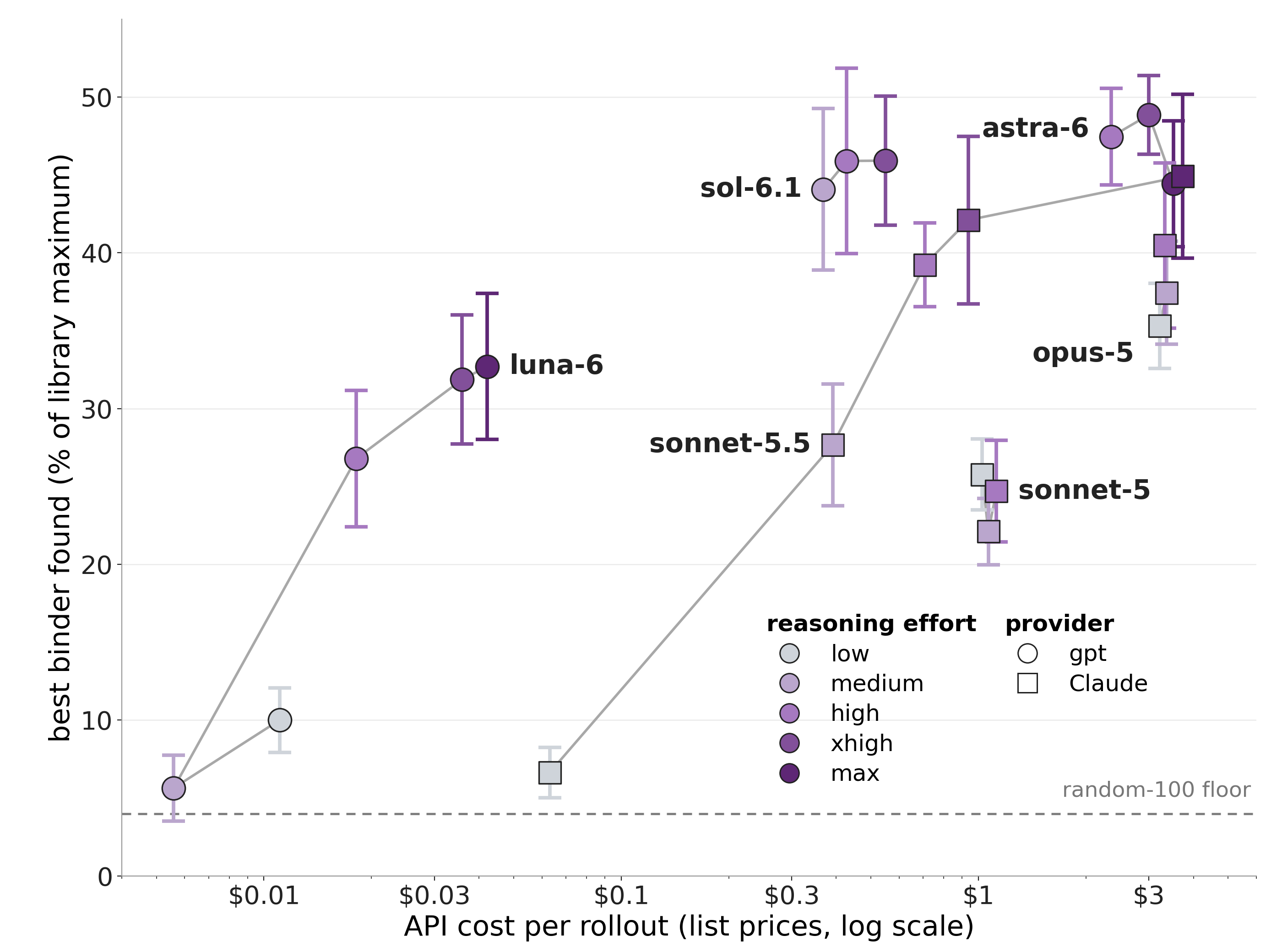
Figure 3. Performance vs. cost on our flagship SAR task. Landscape is composed of 33 targets * ~6M molecules, experimental budget of 100 molecules across 20 iterations. Bars are 95% confidence intervals on the mean of 10 trials per target.
Minos environments can be used to interrogate agent behavior and policies
It’s clear that agents have some priors, but it’s also clear that they are conducting genuine medicinal chemistry campaigns where they learn as they go (see the preprint for more on this).
We can also determine that dumber models stay in unproductive regions of chemical space for longer. Too much exploit, not enough explore (figure 4).
One way we figured this out was by calculating where an agent had better overall chances of finding a hit by exploring molecules nearby what it has already seen or by abandoning that neighborhood entirely. (This is a common experience while seeking fun around the holiday season, when one has multiple social events to go to and is currently attending the first. Is it enjoyable? Or maybe the next is better?)
We then asked when a given model stuck around versus leaving, and found stronger models were more likely to leave overall, and especially more likely to leave when the neighborhoods were crummy (see how low those darker lines dip on the left side of figure 4).
There are other failure modes, too: agents that don’t use their whole budget of molecules, agents that waste their budget rerunning the same molecules over and over, poor belief updating after an experimental contradiction, failure to promote useful candidates to budget spend, and many more. Having access to what an agent says it’s going to do, what it does, the consequences of those actions, and the consequences of all actions it didn’t take, allows us to deeply interrogate the different ways it makes bad decisions.
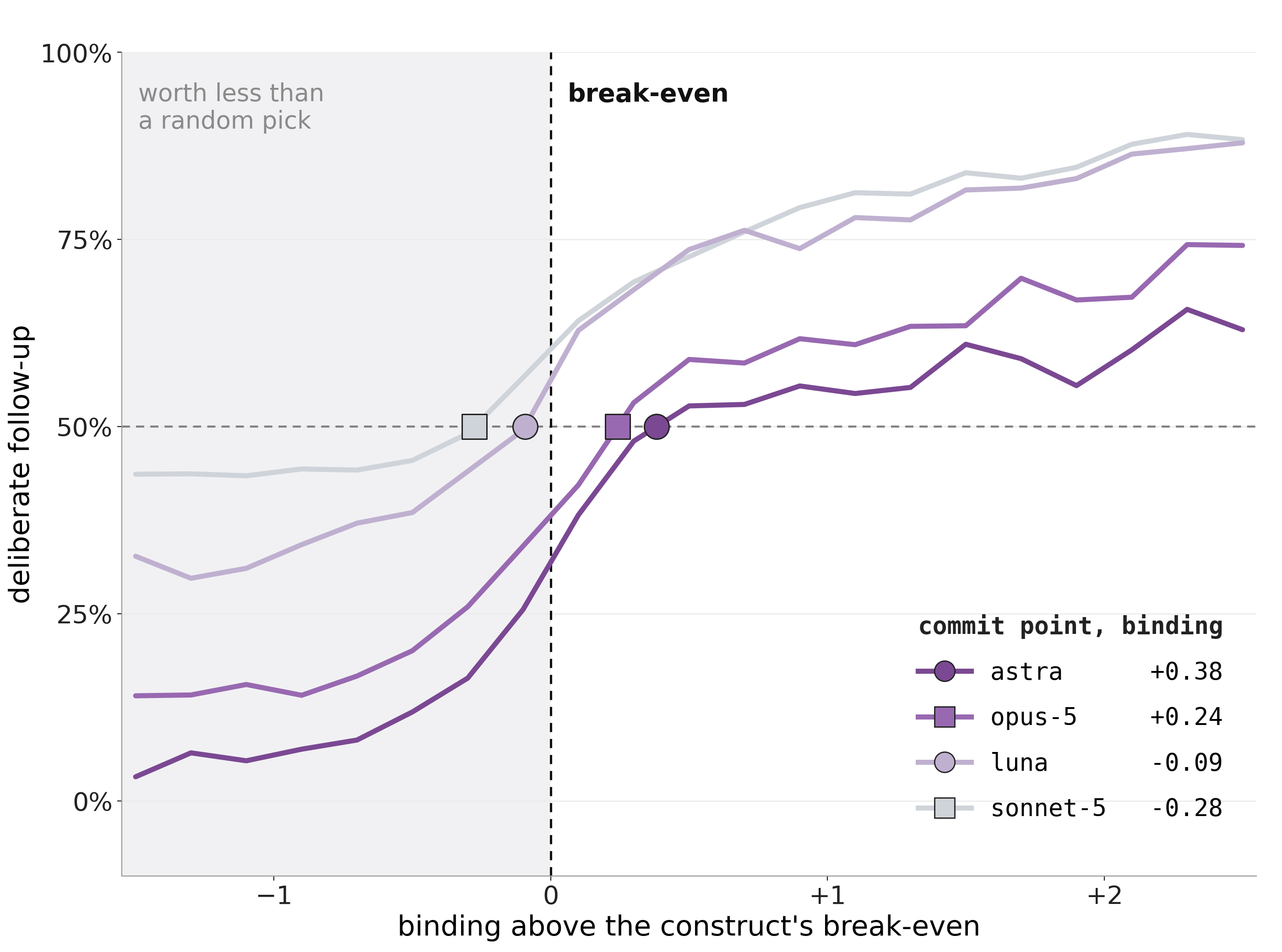
Figure 4. An SAR campaign has a better chance of success if it leaves unproductive chemical neighborhoods rather than attempting to iteratively improve molecules in those neighborhoods. Weaker models persist in local basins; stronger models leave them more frequently, especially those less likely to be productive.
We invite you to look at these yourself
These few vignettes are only the surface: we suspect there is a far more extensive taxonomy of decision failure to be described from these trajectories. We also feel it’s only fair that Minos environments be used to evaluate future agents by the community. To make all this easier for everybody, we are releasing a small number of Minos environments as Harbor packages. We are also releasing a decent number of reasoning traces from agents tackling the SAR task in the Minos environments (“decent number” means thousands). We hope this modest number of worlds inspires others to explore. Please go to strelka.leash.bio to check them out.
What does the future of science look like?
It looks to us like we just built a lab-in-the-loop with zero latency (more precisely, not quite zero latency but modest latency that gets amortized across large numbers of computational runs). We’re using it to understand, and perhaps teach, agentic scientists.
This current crop of Minos environments is restricted to exploring SAR for molecules binding to a particular protein target. Within that framework, there are a number of possible tasks: find the best binder on a limited budget, find binders under variable budget regimes, find binders that are better than this hit and worse than the same hit, rank binders in a given neighborhood after testing some from another neighborhood, and so on. Beyond single targets, we quickly get to a point where we start exploring selectivity or promiscuity questions. With mutant data, we could task agents with finding the amino acid residues most important for this binding, or optimizing for mutant selectivity. These are easy to imagine with existing Minos worlds. That leaves open a question for the next ones.
What other types of physical measurements can we collect to be replayable in the same way? Can we do this with large protein complexes, or cells, or tissues, or whole animals? Signaling pathways? Directed evolution? Host-pathogen interactions?
A key element hiding in all of this is that the whole goal of experimentation might be shifting. If we were solely interested in finding the best binder for a given target, we wouldn’t have agents traversing through the data running these experiments, we’d just look up the most enriched molecule in the screen. Indeed, this is what everyone else does, because that’s usually the goal of such a screen.
We are discovering a different goal here: to find cheap, physical experience for agents to learn on. One might run an experiment to get a result we care about, but now, one might also get a result we care about by running experiments that teach machines to discover it for us.
One possible future role for human scientists is to build worlds for agents to grow up in. We might not even care about the results of the experiments themselves, in the same way AlphaGo didn’t care about how game number 8,000,000 in its self-play regime went. It’s not the result that matters, what matters is that playing the game changes the player.
Almost eighty years ago, Turing pushed for machines to encounter learning environments that had “little contact with the outside world.” It may turn out that we need machines to encounter the outside world for them to do the most useful work. It may be on us to facilitate machine exposure to the outside world at a scale they can learn from, and the best way to get that scale may be sampling pieces of reality so densely that machines can experience it over and over and over again, like they currently do with games and coding and simulations.
"Weaker models persist in local basins" is a hard result to get out of most agent evals. with the whole library premeasured you can score each stay-or-leave call against what leaving would actually have turned up, while a lab-in-the-loop run only finds that out by paying for the experiments it skipped.
Thank you, very interesting and practical. What's your perspective on: RL'ing a language model on trajectories for these campaigns, vs. an active learning campaign with a statistical surrogate model that's Bayesian optimized. Do you get a sense that language models can overcome the latter and why?